Engineering
 Production automation
 Testing
 Virtual accident experience
 Innovation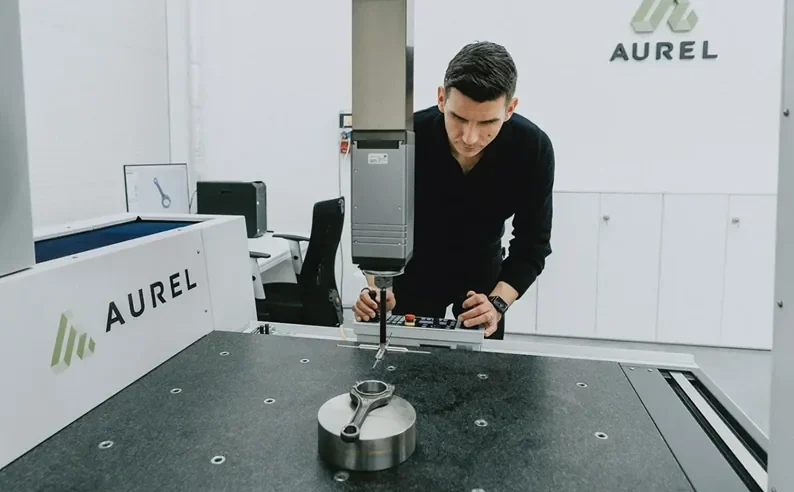
Today, 3D metrology methods are among the pillars of automotive development. Without them, it would not be possible to accurately link digital designs with reality, maintain stable production or reliably evaluate crash test results. How does this field work in practice, which technologies are used at AUREL, and where does three-dimensional measurement deliver the greatest added value? We asked Matúš Frenák, Coordinator for 3D Measurement and Road Safety Projects at AUREL.
What does your role involve?
My work lies at the intersection of technology, organisation and communication. In the field of 3D measurement, I prepare and plan the entire process – from selecting the appropriate technology, through scheduling, to on-site execution. In road safety projects, I am also responsible for leading the “Accident Simulation” programme. From the very first contact with the customer, we fine-tune the purpose, scenario and expected outcomes, which I then translate into a final form in virtual reality. My role is to ensure that both the technical solution and the organisation perfectly match the client’s needs.
How long has AUREL been working with 3D methods?
We have been working with them for more than 20 years. We started with static photogrammetry – our first vehicle deformation measurement projects were carried out on the second-generation Škoda Octavia. Over time, we gained experience through these projects, expanded our know-how and opened the door to additional measurement methods.
How many specialists currently make up the 3D metrology team?
There are eleven specialists in total. Each focuses on a different area – some on static or dynamic photogrammetry, others on 3D scanning or contact measurement. Thanks to this division, we cover both conventional and highly sophisticated procedures and can respond flexibly to the specific requirements of individual projects.
AUREL is part of the Colegium Holding group, where your 3D measurement services are also used by other companies. Can you give an example of how this cooperation works?
For example, we worked with LENAM, where we precisely determined the positions of potentiometers and accelerometers on a real vehicle. The outputs served as a basis for further development. I am convinced, however, that 3D measurement has strong potential across other companies within the holding as well. Whether it is geometry inspection, prototype documentation or development support, our methods can deliver valuable and accurate data in many areas.
What role does 3D metrology play in the vehicle development process?
3D measurement plays a crucial role in vehicle development because it links digital design with real manufacturing. It makes it possible to accurately verify whether physical parts match the CAD model, ensuring dimensional accuracy and product quality. It is already used during prototyping, where it quickly identifies deviations and helps optimise shapes and designs. It is also used to inspect tools, moulds and assembly fixtures.
And how is it used in production?
In production, it ensures continuous quality control and process stability, allowing manufacturers to react quickly to any changes. The result is more efficient development, faster time-to-market and higher reliability and aesthetic quality of the final vehicle. Key applications also include digital body dimension inspection using optical systems such as Zeiss ATOS Q or Faro Focus, as well as deformation analyses after crash tests, where scanning is used to evaluate structural behaviour and material performance.
You use both contact and non-contact measurement methods. When is each appropriate?
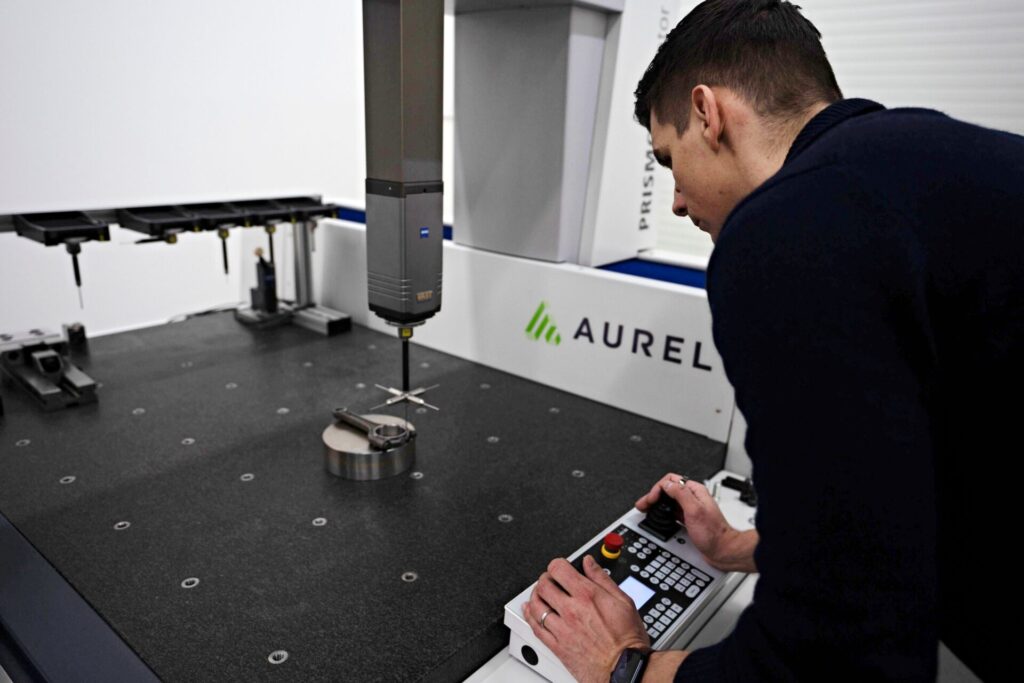
We use non-contact scanners – optical and laser – where a complete capture of the component’s shape is required quickly. This typically applies to body parts, plastic mouldings or design surfaces, where customers expect rapid orientation in shape deviations and visual comparison with the CAD model. Contact methods, i.e. probing with a tactile sensor, are used where extreme point accuracy is essential – for example, holes, pins, mating surfaces or functional geometric elements. In practice, the two methods are often combined: non-contact measurement provides a fast overview of shape, while contact measurement refines critical areas.
What does the measurement process look like in practice?
Everything starts with part preparation. The component is cleaned, positioned in a fixture and secured so that measurements can be repeated under identical conditions. A suitable measurement method is then selected based on the part type and required accuracy – either an optical 3D scanner for rapid surface capture or a contact CMM for maximum point precision. The collected data are then compared with the CAD model, and deviations including tolerance fields are evaluated. The output is a detailed report used by design, manufacturing and quality departments. Its purpose is to identify and eliminate discrepancies before the part enters series production.
What exactly does the customer receive from AUREL?
The standard output consists of 3D colour deviation maps that immediately show where and how the part deviates from the nominal CAD model or from its pre-test condition. The visualisations are complemented by tables with exact dimensional values, tolerances and other critical parameters. If customers need to work further with the data, we also provide an STL model or polygon mesh for use in CAD or metrology software.
And how do automotive manufacturers use this data for further decision-making?
Thanks to these outputs, companies can immediately decide whether a part is within tolerance, whether a tool adjustment is required, or whether intervention in the production process is necessary. This allows them to react quickly and in time, before larger production losses occur.
Testing plays an important role in vehicle development and safety. Which 3D measurement methods do you use in crash tests?
During crash tests, we use both static and dynamic photogrammetry, which allows us to capture fast events in real time in great detail. Subsequent 3D scanning then enables us to precisely document post-impact deformations. The combination of these methods provides a comprehensive and accurate picture of what actually happened during the test. It allows us to carry out detailed deformation analyses after frontal, side and rear impacts – measuring, for example, reinforcement compression, boot deformation, changes in occupant space or shifts in the overall vehicle geometry.
How does photogrammetry actually work?
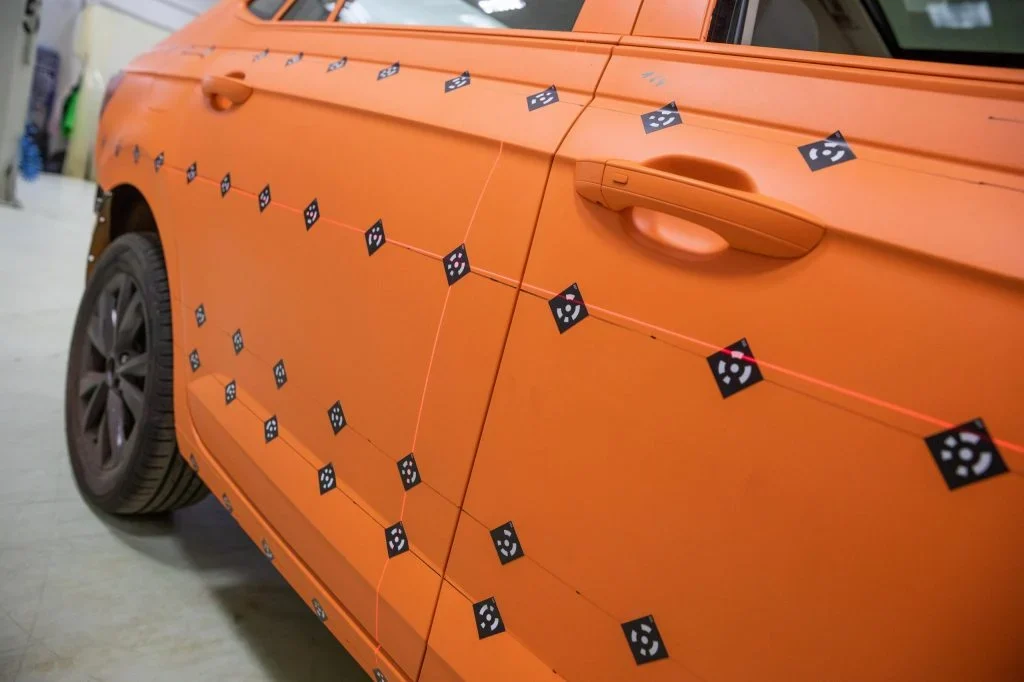
Photogrammetry is a precise 3D measurement method based on a series of photographs and optical markers. A technician places markers on the measured object, takes images from various angles, and software uses triangulation to calculate their exact spatial coordinates. The result is a detailed 3D point cloud that can be compared with CAD data or used for deformation analysis, documentation and simulations. It is an exceptionally reliable and accurate method, ideal wherever non-contact measurement is required.
Is this a common measurement method in the Czech Republic?
It is not yet a common standard in the Czech Republic, but at AUREL we have been using it for more than 20 years. We carry out 100–200 crash tests annually (in the past, even more than 300). We regularly travel to the Škoda Auto crash laboratory, where we measure vehicles after impact tests using static and dynamic photogrammetry as well as 3D scanning. Some components are also scanned before the test itself directly at AUREL.
Finally, may I ask which project in the field of 3D measurement or safety testing has pushed you technically the furthest at AUREL?
Choosing a single project is almost impossible. Each project brings a new challenge – a different material, a specific shape or an atypical customer requirement. Every measurement forces us to think about optimising procedures, accuracy and data processing efficiency. As a result, we constantly work with new technologies and improve the combination of contact and non-contact measurement. Our greatest technical progress therefore comes from the overall diversity of projects, which keeps the team in a constant rhythm of innovation.
Thank you for the interview!