Engineering
 Production automation
 Testing
 Virtual accident experience
 Innovation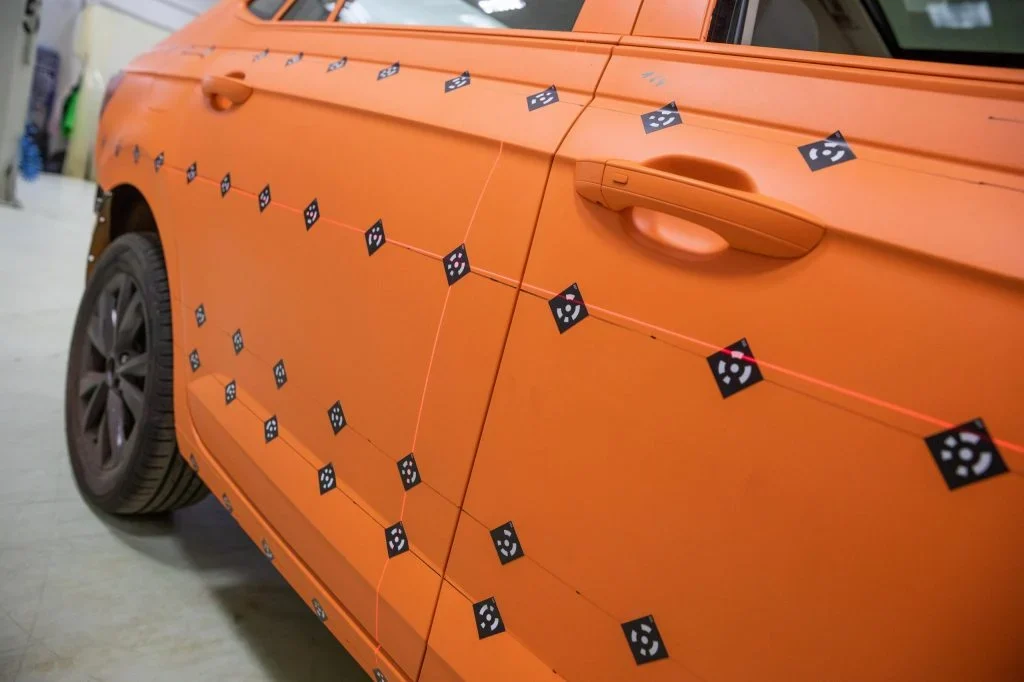
When measurement is mentioned, most people think of a touch probe, measuring arm or a CMM machine. These technologies are an established standard in industry. Modern automotive development, however, increasingly requires faster, more flexible and non-contact solutions for situations where traditional methods are not practical. One such approach is static photogrammetry – precise 3D measurement based on a series of photographs and optical markers.
How does photogrammetry work?
The principle is simple: a technician places optical markers on the object and then takes a series of images from different angles. Specialised software recognises these markers and calculates their exact 3D coordinates using triangulation. During measurement, the object remains stationary, the images overlap, and the result is a 3D point cloud formed by the positions of the markers. This data can then be compared with a CAD model and used for deformation analysis, simulations or documentation.
The benefits? fast, accurate and non-contact
The key advantages of photogrammetry are speed, accuracy and reliability. Components are measured without physical contact, protecting even sensitive parts from damage or deformation. With correct setup, accuracy reaches up to one tenth of a millimetre – exactly the level required for automotive development and testing. Another major benefit is visualisation. Colour deviation or deformation maps significantly simplify the presentation of results. And most importantly: technicians can measure virtually anywhere – in the laboratory or directly at the customer’s site.
Photogrammetry as a daily standard at AUREL
At AUREL, this method is part of everyday practice. The team uses it to measure deformations after crash tests, check deviations and complement other measurement methods – point measurement as well as 3D scanning. An experienced team of specialists, a spacious laboratory, high-quality equipment and up-to-date software ensure that this advanced technology operates reliably and efficiently on a daily basis.
Where does it help?
- Component and assembly inspection: When comparing the actual condition with the CAD model, photogrammetry is often combined with scanning. Scanning provides a complete overview of the part’s geometry, while photogrammetry delivers extremely precise reference data at specific points.
- Pedestrian protection testing: In pedestrian protection laboratories, photogrammetry helps precisely position components, define zones on the vehicle and verify that the vehicle model matches reality before the impactor is launched.
- Special measurements for customers: AUREL frequently handles highly specific tasks – for example, determining the exact position of sensors on a vehicle body. Here too, tenths of a millimetre can be decisive.
Crash tests – daily routine and 20 years of experience
Testing plays a key role in vehicle development and safety. At AUREL, technicians most frequently use photogrammetry during crash tests – on a daily basis. Each year, they carry out 100–200 crash tests (previously even more than 300). The technology enables deformation analysis after frontal, side and rear impacts. Measurements capture how reinforcements compress and how the boot area, passenger compartment and overall vehicle geometry deform during impact.
Static photogrammetry can detect even very small deformations, which is why it is often used for low-speed impacts where deformations reach only a few tenths of a millimetre.
This method is still not a common standard in the Czech Republic. AUREL, however, has been applying it for 20 years and ranks among the leading specialists in the field. Technicians regularly travel, for example, to Škoda Auto’s crash laboratory, where they measure vehicles after impact tests using static and dynamic photogrammetry as well as scanning. Some components are scanned even before testing, directly at AUREL.
A modern method taking measurement to the next level
Static photogrammetry perfectly complements traditional measurement methods. It offers a detailed view of individual locations, enables precise evaluation of deviations and, thanks to its non-contact principle, works even where probes cannot reach. This is why the technology has become a reliable part of everyday practice at AUREL.
Would you like to find out whether photogrammetry could improve the efficiency of your measurement and testing processes? Contact us to discover how maximum precision can enhance the quality of your vehicles and components.