Engineering
 Production automation
 Testing
 Virtual accident experience
 Innovation
When simulating a collision between a pedestrian and a vehicle, head impactors are among the most important testing tools. They enable engineers to assess the risk of injury to the most vulnerable part of the human body. Head injuries are among the most serious consequences of road traffic accidents, as an impact can result in life-threatening conditions or long-term health effects. For this reason, pedestrian head protection receives particular attention during vehicle development.
In the previous parts of this series, we explained what impactors are and why they are among the key tools used in pedestrian safety testing. The second article focused on the impactors used to evaluate bumper impacts on pedestrians’ lower limbs. In this instalment, we will take a closer look at two types of impactors used for head protection testing: the child head impactor and the adult head impactor.
The Basic Principle of the Experiments
During pedestrian protection testing, so-called test zones are defined on the vehicle. For head impact testing, this is based on the WAD parameter – Wrap Around Distance, which is measured using a flexible tape from the ground over the vehicle’s bumper and bonnet. This parameter helps determine the most likely head impact locations in the event of a collision with a pedestrian. According to ECE Regulation No. 127 or the Euro NCAP methodology, it is used to define the test areas on the bonnet. The exact boundaries of these zones are determined in a more complex manner, but generally speaking, the area between the WAD1000 and WAD1500 lines is used for child head impact testing, while the WAD1700 to WAD2500 area corresponds to the impact zone for the head of an adult pedestrian or cyclist.
Head Injury Criterion (HIC)
The primary parameter used in these tests is the HIC – Head Injury Criterion. This metric expresses the probability of a serious head injury based on the acceleration profile recorded by the accelerometers inside the impactor during the impact event, typically over a 15 ms time interval (HIC15). It therefore evaluates not only the peak acceleration value, but also the duration over which the acceleration acts. The test is so important and widely used that some customers commonly refer to pedestrian head impact testing simply as “HIC testing”.
In pedestrian protection tests, HIC values typically range from several hundred to several thousand. A value of around 650 or lower is generally considered a very good result, whereas values above 1,700 indicate a high risk of severe head injury. HIC is therefore a key criterion in vehicle development, providing an objective assessment of how effectively the bonnet structure and the components beneath it can reduce the loads acting on a pedestrian’s head during an impact.
Child Head Impactor (Child/Small Adult Head form Impactor)
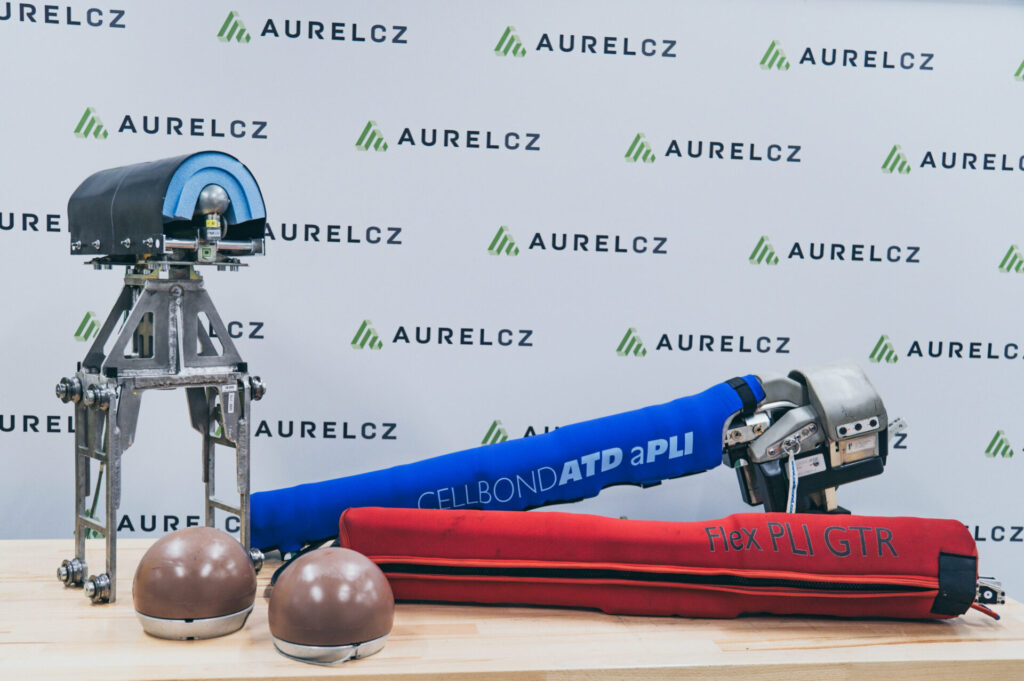
The AC35 impactor simulates the head of a child or a small adult and has a mass of 3.5 kg. It is equipped with an internal tri-axial accelerometer that records the acceleration profile during impact. These tests primarily focus on the central area of the bonnet. During the test, the impactor is launched at a specified speed and angle towards a predefined point on the vehicle body. The recorded data is then used to calculate the HIC value.
At AUREL’s pedestrian protection testing facility, these tests are carried out using one to three high-precision dynamic test systems and a precisely calibrated launching device. Following the impact, engineers analyse not only the acceleration profile but also the deformation of the bonnet and the behaviour of the underlying structure.
Adult Head Impactor
The AD45 impactor simulates the impact of an adult pedestrian’s or cyclist’s head and has a mass of 4.5 kg. It is primarily used for testing the windscreen area and the rear section of the bonnet, i.e. the areas closer to the windscreen and the A-pillars. These parts of the vehicle structure are more complex because they often contain rigid components beneath the surface, such as bonnet hinges, reinforcement members or structural body elements. It is precisely in these areas that achieving low HIC values is most challenging, requiring engineers to strike a balance between structural strength and the ability to absorb impact energy.
in Head Protection: Insights from AUREL Experts
Modern vehicles incorporate several technologies designed to reduce the risk of pedestrian head injuries:
- Active bonnets, which lift upon impact to create additional deformation space.
- Pedestrian airbags, which deploy across the windscreen and A-pillars.
- Optimised deformation zones beneath the bonnet.
- Structural modifications to the bonnet and its reinforcement elements.
AUREL’s testing experience shows that combining these solutions can significantly reduce HIC values and, consequently, the risk of serious injury. One of the key factors is the vehicle’s overall design and the construction of individual body components. Test results are strongly influenced by the combination of the bonnet’s outer and inner panels, the adhesive used and the manufacturing technology applied.
“Experience also shows that critical bonnet areas, such as hinges, latch mounting points and other structurally rigid components, require special design considerations and careful preparation with head impactor testing in mind. The windscreen also plays an important role and, when properly designed, can be relatively safe due to its ability to deform. However, the key factor is the critical time interval between the head making contact with the windscreen and the moment the glass fractures,” explains Miroslav Pažout, Head of Testing at AUREL.
Pedestrian Protection Testing Saves Lives
Together, leg and head impactors form a comprehensive system for pedestrian protection testing. They enable vehicle developers to objectively assess vehicle safety and continuously improve injury prevention measures. As vehicle technology evolves, alongside new safety regulations and advanced engineering solutions, both testing methodologies and impactor technologies will continue to develop. The goal, however, remains unchanged: to minimise the consequences of vehicle-to-pedestrian collisions and protect what matters most – human life.
Are you interested in pedestrian protection testing or the testing capabilities available at AUREL’s dynamic testing laboratory? Do not hesitate to contact us. We will be happy to discuss the specific requirements of your project with you.